Seamless ERP software as the foundation for automation, RFID and AI in laundry operations
Digitalisation has long since become a reality in textile services. Wash lines are becoming more powerful, systems increasingly interconnected, and automation is being introduced across more and more process stages. At the same time, laundries are facing familiar challenges: labour shortages, rising costs, high time pressure, and growing demands for transparency and traceability.
Technologies such as RFID, robotics and, increasingly, AI offer significant potential. However, the decisive factor is not the individual technology itself, but how effectively it is embedded in seamless processes. Only a consistent data foundation across all areas enables genuine efficiency gains.
Industry-specific software: close to real-world practice
Particularly in textile services, it becomes clear that standard software quickly reaches its limits. Production logic, circulation management, customer structures and billing models follow industry-specific requirements that cannot easily be generalised. This is why the value of a software solution developed specifically for the laundry and textile service industry is so high.
SoCom has been developing its ERP solution TIKOS in close collaboration with textile service providers for many years. Guided by the principle “From the industry. For the industry.”, a practice-oriented system has emerged that reflects real operational processes, grows with the requirements of businesses and consistently keeps automation in focus. This close exchange ensures that functionality directly supports day-to-day operations in production, logistics and administration – rather than missing practical needs.
Seamless processes instead of stand-alone solutions
In many businesses, administration, production, logistics and billing have evolved separately over time. Different systems and manual interfaces result in data discontinuities, duplicate entries and unnecessary coordination effort.
Seamless ERP systems address this challenge directly by linking all process steps – from order entry and sorting through wash lines, finishing and route planning to invoicing – within a single, consistent logic. The result is reliable data, higher process quality and improved control of daily operations.
Automation requires clean, reliable data
Robotics and automation only deliver their full benefits when process data is clearly defined and up to date. Status information, priorities and material flows must be transparent in order for automated processes to function reliably. Seamless software processes provide the necessary visibility and reduce manual workloads – a key advantage in times of labour shortages.
RFID: more than identification
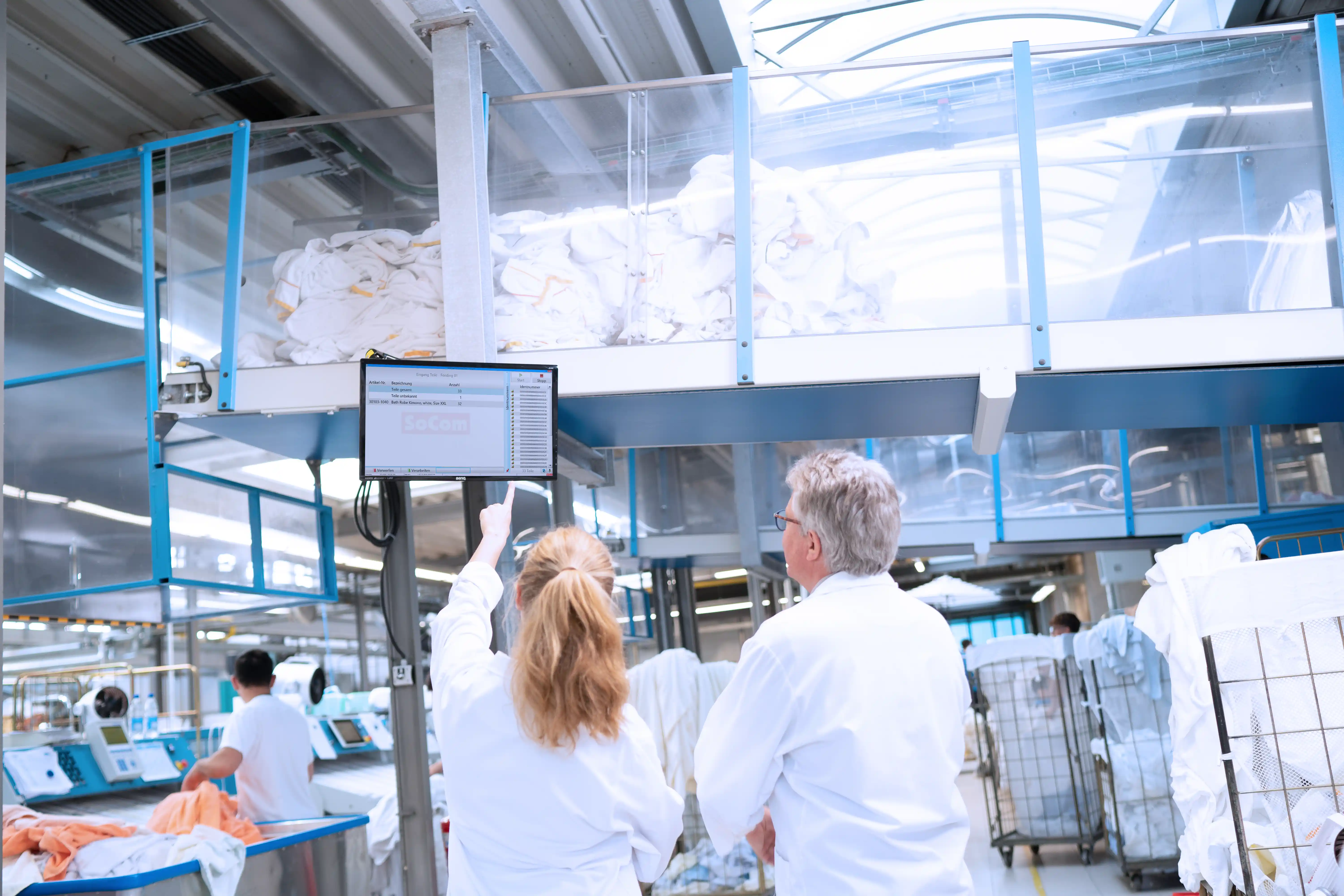
RFID enables the automated capture, tracking and documentation of textiles. Manual activities such as counting or searching are reduced, error rates decrease and turnaround times are shortened.
In addition, containers and transport units can also be tracked transparently. This makes it clear where a container is located and how long it remains in circulation. Beyond improved process reliability, this also opens up new billing and service models, for example chargeable container rental.
Modular and scalable – suitable for any business size
Digitalisation is not a one-size-fits-all project. Laundries differ significantly in size, customer structure and level of automation. Modular ERP platforms allow businesses to start with their current requirements and expand functionality step by step – without system changes and without disrupting processes.
Outlook: machine connectivity and AI
As machine connectivity increases, growing volumes of data are generated across production, sorting and logistics. When this information is centrally consolidated, it forms the basis for data-driven optimisation including AI-supported planning and decision-making. The prerequisite remains a seamless, consistent data structure that effectively links operational practice and automation.
Conclusion
Anyone looking to use automation, RFID and, increasingly, AI in an economically viable way needs one thing above all: seamless processes and reliable data. Industry-specific ERP systems such as TIKOS provide this foundation – ensuring stable operations today and supporting the ongoing evolution towards Laundry 4.0 tomorrow.
 CONTACT US